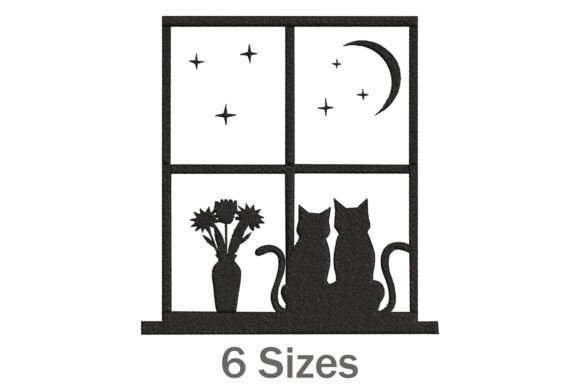
Two Cats in a Window
First Impression: Whimsical Charm with Quiet Confidence
As an embroidery designer who’s prepped over 200 craft fair booths—and watched which designs stop foot traffic dead in its tracks—I took one look at Two Cats in a Window and felt that familiar spark: this isn’t just another cat motif. It’s not overly cutesy, nor is it starkly minimalist. It lands perfectly in the sweet spot between whimsical and elegant, with just enough narrative to invite a smile and enough visual balance to feel intentional. That “enchanting” descriptor in the product description? It’s accurate—but only if you execute it right. This design reads as handmade with care, not mass-produced. That’s gold for boutique makers, Etsy sellers, and small shop owners building trust through authenticity.
Where It Shines: Craft Fair-Ready Product Pairings
Tote bags are the undisputed MVP for Two Cats in a Window. Positioned front-and-center on a natural canvas or oatmeal linen tote, the design feels grounded, warm, and quietly sophisticated—ideal for shoppers seeking functional art. On aprons, especially denim or medium-weight cotton, it adds personality without overwhelming utility. For tea towel embroidery, size matters: use it as a centered focal point (not tucked in a corner), and pair with clean hemstitching to elevate perceived value. As an embroidered patch, it works beautifully on denim jackets or market bags—its shape lends itself to clean edge finishing and confident visibility.
It also performs well on pillow covers (especially 16”–18” square or lumbar sizes), where the window framing creates natural negative space around the cats—no crowding, no visual fatigue. On caps, proceed with caution: the composition isn’t inherently curved-surface friendly, so test placement high on the front panel—not near the bill seam. And while it *can* work on small fabric pouches, avoid scaling below 3.5 inches wide; tiny paws and window panes blur fast.
Real-World Selling Strengths
This design grabs attention quickly—no decoding needed. At a busy craft fair, where buyers scan booths in under three seconds, Two Cats in a Window delivers instant recognition (cats), emotional resonance (cozy, nostalgic, gentle), and aesthetic cohesion (balanced, rhythmic, softly detailed). It photographs exceptionally well for Etsy listings and printable mockups: soft shadows, clear outlines, and inherent symmetry make lighting forgiving. As a commercial embroidery asset, it feels repeatable—ideal for batch production of matching sets (e.g., towel + pouch + patch) without looking monotonous.
Crucially, it supports brand consistency. Whether you’re known for farmhouse charm, modern cottagecore, or quiet luxury, Two Cats in a Window adapts—just adjust thread colors and fabric base. Navy thread on ivory linen reads refined; mustard and sage on unbleached cotton reads earthy. That flexibility strengthens your booth display and builds customer recognition across product categories.
Careful-Use Notes: Protect Your Stitch Quality
Don’t assume this design auto-translates across substrates. Its charm lives in subtle contrast—so thread colors must be chosen deliberately, especially on dark fabric. Test contrast on scrap first: light gray thread on black twill may vanish; ecru on charcoal linen often sings. On textured towels or terry cloth, increase stabilizer layers—this isn’t a low-density machine embroidery design; those window lines and cat contours need support to stay crisp.
Avoid dense stitch areas near the cats’ eyes or window muntins unless your stitch density is optimized—over-stuffing causes puckering on lightweight fabrics. And never skip testing on your actual end fabric: a design that looks perfect on smooth quilting cotton may ghost or distort on slubby linen or stretchy knit. If using it on caps, confirm your hoop size accommodates the full width comfortably—no last-minute trimming mid-embroidery.
Design Integrity Checks Every Embroidery Designer Should Make
Before cutting your first production fabric, run these checks:
- Test the embroidery file on scrap fabric matching your final product’s weight and texture;
- Verify thread contrast—hold samples under both natural and booth lighting;
- Review spacing: does the window frame leave breathing room on all sides when stitched at your intended size?
- Confirm your stabilizer choice aligns with fabric movement—cutaway for knits, tear-away for stable wovens, fusible + tear-away for towels;
- Create at least one real-life finished product mockup—not just digital—and hold it at arm’s length to assess clarity;
- Compare how it reads across three fabric colors (light, medium, dark) to guide your product palette;
- And critically: verify commercial licensing status before selling any handmade product containing this design. When in doubt, contact the source—never assume.
Why It Converts at Market—and Online
Two Cats in a Window taps into enduring emotional appeal—cats, windows, quiet moments—without leaning on trend-chasing clichés. It feels like a shared secret, not a slogan. That translates directly to buyer engagement: customers linger, point, ask about the story behind it. At craft fairs, I’ve seen this exact energy turn casual browsers into repeat buyers—especially when paired with cohesive small shop product offerings (e.g., a tea towel + matching embroidered pouch + mini print). Online, it boosts perceived value: a $28 tote with Two Cats in a Window sells faster than the same tote with generic florals, because it signals curation, not convenience.
For digital embroidery file sellers, this design has strong cross-category legs—it’s equally viable for home crafters using Cricut machines and professional digitizers building design assets for boutique brands. Just remember: its strength lies in restraint. Let the cats lean into the sill. Let the window frame breathe. Don’t over-accessorize it with extra flourishes—it’s already complete.