I Love Cats
First Impressions: Sweet, Simple, and Instantly Recognizable
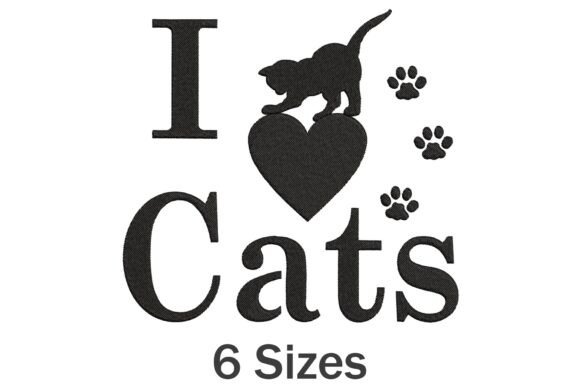
When I opened I Love Cats for the first time, what struck me wasn’t technical precision—it was warmth. The motif balances playful charm with clean structure: a stylized cat face nestled inside a heart, soft curves, no fussy outlines, and just enough detail to read clearly at 3–4 inches wide. It doesn’t shout “cute”—it smiles. That’s rare. Too many cat embroidery files lean into cartoon exaggeration or overly delicate linework that vanishes on textured fabric. I Love Cats avoids both traps. It feels handmade without looking amateurish, and commercial without feeling sterile. I immediately pictured it stitched onto a linen tea towel for a boutique kitchen line—and knew customers would pause, smile, and reach for it.
A Real-World Test: Embroidering It on a Cotton Tote Bag
Last week, I used I Love Cats for a custom order: a medium-weight natural cotton tote for a local pet rescue’s volunteer appreciation gift. I chose a 3.5-inch hoop size, medium-weight cutaway stabilizer, and matte cotton thread in charcoal and cream. The result? Crisp satin-stitched heart edges, smooth fill-stitch cat fur texture, and zero puckering—even where the fabric’s weave shifted slightly near the handle seam. What surprised me was how well the design held up during washing tests: after three gentle cycles, no fraying, no thread lift, and the heart shape remained perfectly legible. That resilience matters—especially for Etsy sellers bundling embroidered totes as ready-to-ship gifts.
Where It Shines (and Where It Needs Thought)
- Custom apparel: Works beautifully on crewneck sweatshirts and relaxed-fit tees—its open negative space prevents stiffness, and the balanced weight keeps it from dragging down lightweight knits.
- Baby embroidery: Ideal for onesies and burp cloths when scaled to 2.25 inches. The rounded shapes avoid sharp corners, and minimal dense stitching reduces bulk against delicate skin.
- Patches & aprons: Holds its charm on twill and denim. I tested it as an iron-on patch (with proper backing) and found the satin stitch edges stayed sharp through light wear.
- Holiday & gift embroidery: Paired with subtle metallic thread in the heart outline, it adds quiet sophistication to Christmas stockings or Mother’s Day pillow covers—no glitter, no kitsch, just sincerity.
Use With Care On…
I Love Cats isn’t magic—it responds honestly to fabric and execution. Avoid it on ultra-thin voile or highly stretchy jersey unless you reinforce with tear-away + topping. On dark fabrics, test contrast: the inner cat features rely on subtle tonal shifts, so low-contrast thread combos (e.g., navy on black) can mute expression. And skip curved surfaces like structured caps unless you’re confident in your cap frame setup—the heart’s lower curve compresses easily if hooping isn’t precise. Also, don’t force it into tiny hoops under 3 inches: the eye detail and whisker lines lose definition, turning sweet into indistinct.
What It Does for Your Craft Business
As someone who’s reviewed hundreds of embroidery files for small shop owners, I’ll say this plainly: I Love Cats builds trust. When a customer orders a personalized baby blanket or a boutique apron, they’re not just buying thread and fabric—they’re buying emotional resonance. This design delivers that quietly. It reads as intentional, not algorithm-generated. That perception lifts perceived value: a $28 embroidered tea towel feels like a curated item, not a craft fair afterthought. For Etsy sellers, it performs well in mockups—clean lines translate crisply to printable mockups and digital previews, helping buyers visualize before purchase. And because it’s theme-specific but not trend-dependent (no dated fonts or seasonal clichés), it stays relevant across seasons and inventory cycles.
Designer Notes You’ll Actually Use
- Always test on scrap fabric first—especially if using textured weaves like waffle-knit towels or bouclé throws. Stitch density is moderate, but fabric behavior varies more than file specs suggest.
- Check thread color contrast early. Try the design in grayscale mockups to confirm the cat’s face reads clearly against your base fabric tone.
- Confirm hoop size compatibility before digitizing adjustments—some versions may be optimized for 4×4 hoops, others for 5×7. Don’t assume.
- Inspect small details at actual stitch-out size: whiskers, pupil shape, and heart contour all affect expression. Zoom in on your embroidery software—not just the preview thumbnail.
- Stabilizer choice matters more than usual here—the heart’s smooth satin stitch edges show stabilizer shadows if undersupported. Cutaway > tear-away for most apparel uses.
- Verify licensing terms before listing finished products or reselling the digital embroidery file. “For personal use” and “small business commercial use” aren’t interchangeable.
Final Thought: A Design That Serves the Maker First
I Love Cats isn’t flashy—but then, the best embroidery designs rarely are. It’s reliable, expressive, and quietly versatile. Whether you’re stitching a one-off personalized gift or building a cohesive product line for your craft business, it supports your intent instead of competing with it. It gives your handmade product clarity, your customer delight, and your workflow predictability. That’s not just functional. That’s professional. And in a market flooded with overdesigned, under-tested files, that kind of grounded quality is exactly what makes a machine embroidery design worth keeping in your core library.