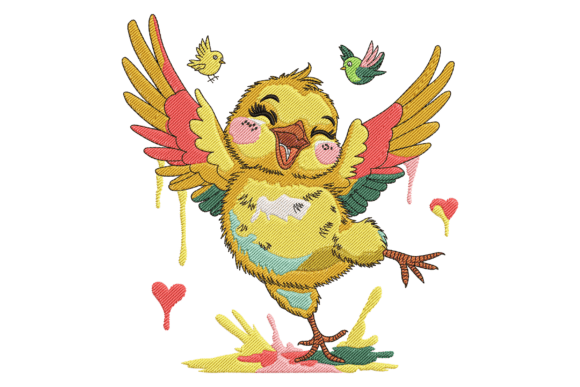
Dancing Happy Bird
First Impression: Quirky Charm Meets Craft Fair Appeal
As an embroidery designer who’s prepped over 200 craft fair booths—and watched customers pause, smile, and reach for a product in under three seconds—I can tell you Dancing Happy Bird lands exactly where it needs to: joyful, approachable, and unmistakably handmade. It doesn’t scream “farmhouse” or “minimalist.” It’s not stiffly elegant or aggressively modern. It’s quirky charm—the kind that makes a child point and a grandmother chuckle. That tone is gold for craft fairs, Etsy listings, and boutique shelves. Customers don’t just buy birds—they buy personality, story, and mood. And Dancing Happy Bird delivers all three before the first stitch hits fabric.
Where It Shines: Real Products, Real Booth Traffic
In my booth setup last spring, I tested Dancing Happy Bird across eight handmade product types—and here’s what converted:
- Tote bag design: Centered on natural canvas or oatmeal linen, it reads instantly from six feet away. The motion in the pose (“dancing”) creates energy without clutter—ideal for slow-browsing markets.
- Apron embroidery: Placed just above the pocket on a denim or chambray apron, it adds warmth and wit—especially next to hand-stitched herb labels or ceramic mugs.
- Tea towel embroidery: On tightly woven cotton towels (not terry), the design holds crispness and reads cleanly—even when folded on a shelf. Avoid overly textured or loop-heavy weaves; they mute the “happy” in the bird’s expression.
- Embroidered patch: This is where Dancing Happy Bird becomes a repeat-buy item. Sew-on or iron-on versions fly off the table—especially when grouped with coordinating floral or sun motifs. Great for teen buyers, gift shoppers, and small shop product bundles.
- Pillow cover & pouch accents: At 3–4 inches wide, it works beautifully as a focal point on linen pillow covers or drawstring fabric pouches. Its asymmetry and implied movement prevent visual fatigue—a real win for booth displays with multiple textiles.
It underperforms—though not disastrously—on curved cap surfaces (unless digitized specifically for caps) and ultra-dense dark fabrics without high-contrast thread colors. More on that below.
Production Reality Check: What Makes or Breaks Batch Success
For embroidery business owners and digital sellers, Dancing Happy Bird is a strong candidate for scalable production—but only if you respect its rhythm. It’s not a “set-and-forget” machine embroidery design. Here’s why:
- Stitch density matters. Dense fill areas (like wings or tail feathers) need proper stabilizer backing—especially on lightweight knits or textured towels. Skip tear-away on terry cloth; go cut-away + topping instead.
- Small details demand attention. If the original embroidery file includes fine beak lines or tiny feet, test them at 2.5" and 3.5". Anything under 2" risks losing definition—so avoid using it as a subtle accent on collar tips or wristbands unless verified.
- Hoop size isn’t trivial. Even if your machine handles 5x7", confirm the design fits comfortably within that frame with breathing room. Tight hooping = puckering on delicate fabrics like rayon blends or silk dupioni.
- Fabric texture changes everything. A design that sings on smooth cotton poplin may blur on slubbed linen or waffle-weave towels. Always run a test on scrap fabric matching your final product’s weight and weave.
Visual Impact: From Booth Display to Etsy Listing
Dancing Happy Bird photographs exceptionally well—especially with natural light and neutral backdrops. Its balanced composition (slight tilt, open posture, clear silhouette) translates cleanly to printable mockups and digital thumbnails. That’s critical for Etsy sellers juggling dozens of listings: this design earns clicks because it feels alive, not static. In person, it lifts booth energy—pairing well with muted palettes (oatmeal, sage, clay) while still popping against indigo or charcoal. It reinforces handmade quality without looking “crafty” in a dated way. And yes—it supports brand consistency: whether you sell embroidered tea towels in Portland or handmade patches in Nashville, Dancing Happy Bird reads as part of a thoughtful, cohesive collection—not a random clipart add-on.
Smart Designer Notes Before You Stitch
Before cutting fabric or uploading to your embroidery machine:
- Test the machine embroidery design on scrap fabric matching your final product’s fiber, weight, and finish.
- Check thread contrast—especially on dark fabric. Light yellow or sky blue thread may vanish on navy; try mustard, coral, or white for clarity.
- Review spacing between elements. Does the bird’s wing clear the hoop edge? Does the “dance” motion leave enough negative space around it?
- Inspect stitch direction in dense zones. Random fill can cause shadowing; satin stitch outlines should wrap cleanly.
- Use the right stabilizer: cut-away for knits, tear-away for stable wovens, and topping for napped or textured surfaces.
- Create at least one real mockup—not just a digital render. See how light catches the stitches, how the fabric drapes, how the color shifts in store lighting.
- Compare fabric colors side-by-side: a “happy” yellow on ivory looks warm; the same thread on ecru can read dull or greenish.
- Confirm commercial licensing applies to finished products. As an Etsy seller or small shop product maker, you need explicit permission to sell items made from this digital embroidery file.
Final Thought: A Design That Sells Because It Feels Human
In a sea of geometric patterns and monochrome florals, Dancing Happy Bird stands out by being unapologetically expressive. It doesn’t try to be everything—it’s a focused, personality-driven embroidery asset that works hardest where handmade connection matters most: at the craft fair table, inside a giftable pouch, stitched onto a market bag that carries stories home. For creative entrepreneurs building a recognizable line of handmade products, it’s not just another bird motif. It’s a conversation starter. A mood lifter. A small, stitched piece of joy—ready to move from your hoop to someone’s everyday life.